
Comparison guide · Rolex vs Omega
Rolex or Omega: the same jobs, two different answers.
A plain comparison for a buyer choosing between the two brands: which models face each other, how movements and materials differ, what retail availability looks like, and how each tends to trade pre-owned. No prices.
- Submariner against Seamaster Diver 300M, Daytona against Speedmaster, Datejust against Aqua Terra
- In-house calibres on both sides, two certification routes
- What the dealer buys, trades, and sources from both brands
Who this guide is for
Two great watches, one wrist.
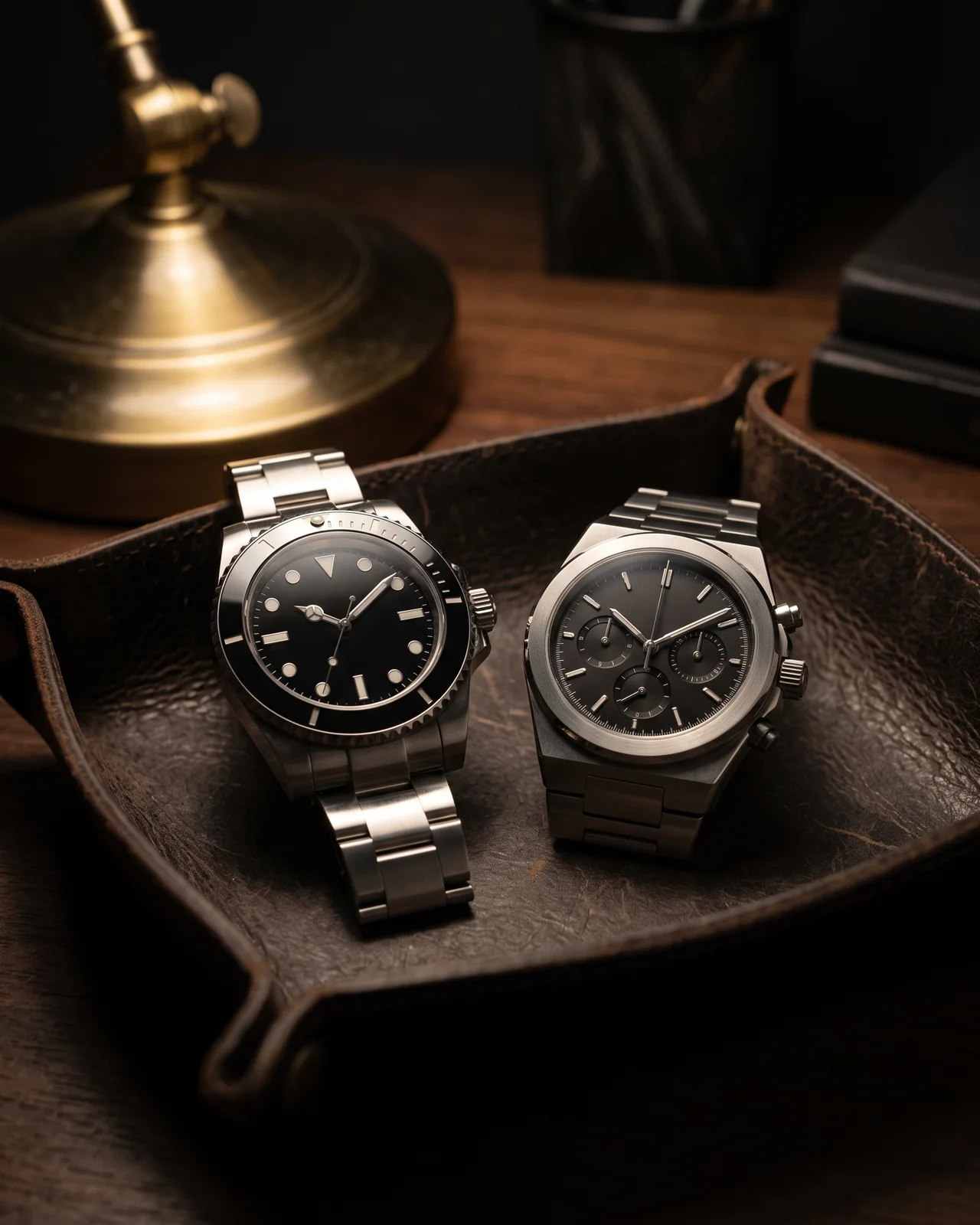
This guide is for a buyer who has narrowed the choice to a Rolex or an Omega and wants a clear-eyed comparison before committing. The two brands build watches for the same jobs: diving, chronograph timing, travel, and daily wear. They go about it differently, and those differences matter more than the logo.
The comparison stays with facts a reader can check: the models that face each other, the movements, the materials, retail availability, service, and how the secondary market tends to treat each, in direction only. No prices: a number on a page goes stale faster than the reasoning behind it.
The last section is mine. I buy, trade, and source both brands, so it explains what that means if you own one and want the other.
How to decide
Four questions that settle most Rolex or Omega choices.
01
Name the job
Diving, a chronograph, a travel watch, or an everyday piece. Each brand has a model for each job, and the pairs below line them up. Decide the job before the brand.
02
Compare the pair, not the brands
Put the Submariner next to the Seamaster Diver 300M, or the Daytona next to the Speedmaster. Size, bezel, crystal, bracelet, and movement differ in ways you can see and feel.
03
Decide new or pre-owned
Rolex steel sport models are generally on allocation at retail. Omega is generally available. That decides whether new is even an option this year.
04
Think about the exit
Most owners sell or trade eventually. Rolex sport references tend to be the easier sale. Omega tends to be the easier purchase.
The detail
Rolex and Omega, point by point.
Two brands, two ideas of what a watch should be
Rolex builds a narrow catalog and changes it slowly. The Submariner, Datejust, GMT-Master II, Daytona, and Explorer have kept their shape for decades, so the watch is recognised at a glance and rarely looks dated. Omega builds a wider catalog and experiments more: the Speedmaster is tied to the Apollo missions, the Seamaster to professional diving and James Bond, and the brand has pushed movement technology with the Co-Axial escapement and anti-magnetic calibres. There are more sizes, dials, and limited editions, and more variation in how they trade later.
The models that face each other
The Submariner faces the Seamaster Diver 300M: both steel, both rated to 300 metres, both with a unidirectional ceramic bezel. The Submariner is 41 mm with the Glidelock clasp and a solid back. The Diver 300M is 42 mm with a wave dial, a helium escape valve, and a display back on most versions.
The Daytona faces the Speedmaster Moonwatch: an automatic chronograph with a Cerachrom bezel against a hand-wound one with hesalite or sapphire. The Datejust faces the Aqua Terra as the everyday watch, and the Explorer faces the Railmaster or a plain Aqua Terra as the no-date field watch.
Movements and certification
Rolex fits its own calibres across the whole range: the 32xx family for time and date, the 3285 in the GMT-Master II, and the in-house chronograph calibre in the Daytona. Each finished watch is tested to the Superlative Chronometer standard, Rolex's own test applied after COSC.
Omega fits its own Co-Axial calibres across most of the range: the 8800 and 8900 families in the Seamaster and Aqua Terra, the hand-wound 3861 in the Moonwatch. Current models are Master Chronometers, tested by METAS, the Swiss federal metrology institute, for accuracy and resistance to magnetic fields. One certificate is independent, the other in-house. Keep the card either way.
Materials, crystals, and finishing
Rolex uses its own Oystersteel, a 904L alloy, Cerachrom ceramic bezels on sport models, sapphire with a Cyclops over the date, and solid case backs. Omega uses 316L steel, ceramic bezels and dials on the Diver 300M, and sapphire everywhere except the hesalite Moonwatch. Display backs are common on Omega, and the brand works more with Sedna gold, titanium, and two-tone, so there is more choice of material within one reference.
Buying at retail: allocation against availability
This is the difference most buyers feel first. Rolex steel sport models are generally allocated by authorized dealers, with a wait and no fixed date; precious metal and dress references are often easier, and Rolex runs a Certified Pre-Owned programme through its dealers. Omega sells through boutiques, dealers, and its own website, and most references are generally available the same week. With Omega, new is a real option. With a steel Rolex sport model, pre-owned is often the only way to own the watch this year.
Service, parts, and warranty
Both brands give a five-year warranty on current production, dated from the card. Rolex suggests a service roughly every ten years on current calibres, at a Rolex Service Centre or through a dealer. Omega's guidance is a shorter interval, at an Omega boutique or service centre. Both keep parts within their own networks. On older watches a service can replace dials, hands, and bezels, which lowers collector interest, so keep old parts and the receipt.
How each trades pre-owned
In direction only. Rolex steel sport references tend to hold close to their retail price on the secondary market and have at times sold above it. The buyer pool is wide, so a well-kept Submariner or GMT-Master II with its card is generally a fast sale.
Omega references generally sell below retail once pre-owned, which is exactly why pre-owned Omega is good buying. The Moonwatch and the Diver 300M have the widest buyer pool. Limited editions and vintage pieces trade on their own terms, with the full set and original parts doing most of the work.
New or pre-owned, for each brand
For a steel Rolex sport model, pre-owned is usually the practical route; a recent example with card and box is close to new in every way that matters. For Omega, new is the simple route and pre-owned is the value route: a Seamaster or Moonwatch a few years old with both cards gives up little.
Trading one toward the other
The common move is from Omega toward Rolex. An owner buys a Seamaster or a Speedmaster, then wants the Submariner or Daytona it was compared with, and the Omega becomes the deposit. The reverse happens too, usually to turn one watch into two.
What I buy, trade, and source from both brands
I buy and sell both brands, and I source what is not in the case. If you own an Omega and want a Rolex, send photos and I credit the Omega toward a watch in stock or one I find for you. If you own a Rolex and want an Omega plus cash back, the same applies. Have these ready:
- The reference number; for an Omega, the line and calibre if known.
- The warranty card and, on a Master Chronometer, the METAS card.
- Box, spare links, and service records, or a note that you do not have them.
- Which direction: sell, trade, or source.
Side by side
Rolex and Omega at a glance.
Facts a buyer can check, with market behaviour in direction only.
| Criteria | Rolex | Omega |
|---|---|---|
| Movements | In-house: the 32xx family, the 3285 GMT, the Daytona chronograph | In-house Co-Axial: the 8800 and 8900 families, the hand-wound 3861 |
| Certification | Superlative Chronometer, Rolex's own test after COSC | Master Chronometer, tested by METAS, with a certificate card |
| Steel and bezels | Oystersteel (904L); Cerachrom ceramic bezels on sport models | 316L steel; ceramic bezels and dials on the Diver 300M |
| Crystal and back | Sapphire with a Cyclops; solid case back | Sapphire, hesalite on the Moonwatch; display back on most |
| Retail availability | Steel sport models generally allocated | Most references generally available |
| Warranty and service | Five years; service roughly every ten years | Five years; a shorter service interval |
| Pre-owned behaviour | Sport references tend to hold close to retail; fast to sell | Generally sells below retail; good value pre-owned |
| Suits a buyer who | Wants one watch recognised anywhere, easy to sell | Wants the watch now, a display back, more dials |
Directions, not figures. The reference, its condition, and the cards move every row.
Questions, answered
Rolex or Omega, in short
Which should I buy, a Rolex or an Omega?
Buy the one that fits the job and the budget you have now. If you want one watch recognised everywhere and easy to sell later, and you can wait or buy pre-owned, the Rolex. If you want the watch this week, a display back, and more dials, the Omega.
Can I trade my Omega toward a Rolex?
Yes. I credit the Omega against a Rolex in the case or one I source. Send photos of the dial, case back, and cards, and I reply within 1 business day with the credit and the reasoning.
Which is easier to sell later, a Rolex or an Omega?
Generally the Rolex, if it is a steel sport reference with its card: the buyer pool is wider and the price tends to stay closer to retail. An Omega sells too, usually at more of a discount from retail, with the Moonwatch and the Diver 300M the easiest of the line.
The pairs
Four matchups that cover most of the decision.
Each pair does the same job. The differences are size, movement, crystal, and resale.
Submariner and Seamaster Diver 300M
Both steel, 300 metres, ceramic bezel. The Submariner: 41 mm, solid back, Glidelock clasp. The Diver 300M: 42 mm, wave dial, helium valve, display back.
Daytona and Speedmaster Moonwatch
The Daytona is automatic with a Cerachrom bezel. The Moonwatch is hand-wound with hesalite or sapphire. The Daytona is the harder watch to buy new.
Datejust and Aqua Terra
The everyday pair. Fluted or smooth bezel, Jubilee or Oyster, and a Cyclops on the Datejust. A teak-pattern dial, a display back, and more dial colours on the Aqua Terra.
Explorer and Railmaster or Aqua Terra
The plain no-date watch. The Explorer is 36 or 40 mm with a 3, 6, 9 dial. The Railmaster carries Omega's anti-magnetic heritage; a plain Aqua Terra adds a date.
Ownership
What each brand gives its owner.
The things owners of each brand tend to value most.
Rolex: recognised at a glance
The shapes have barely changed in decades. A Submariner or Datejust reads as what it is across a room.
Rolex: the easier sale
Steel sport references tend to hold close to retail and sell quickly with a card.
Rolex: long service intervals
Roughly ten years between services on current calibres, so the watch stays on the wrist.
Omega: available when you want it
Most references can be bought new this week, in the dial and size you want, with a full warranty.
Omega: an independent certificate
METAS tests the finished watch for accuracy and magnetic resistance, and the card travels with it.
Omega: more to choose from
Display backs, ceramic dials, Sedna gold, titanium, and limited editions.
Sell, trade, or source
Own one, want the other? Start here.
I buy, trade, and source Rolex and Omega. Send photos of what you have, or tell me what you want, and I reply personally within 1 business day.