
Reference · Glossary
Watch terms, defined the way they are used in an offer.
Four sections: general terms, movements and complications, materials, and condition and paperwork. Each term in a sentence or two, with what it does to the number where it does anything.
- General: reference, serial, full set, grey market, comparables
- Movements: in-house, Co-Axial, GMT, chronograph, perpetual calendar
- Materials and condition: Oystersteel, Cerachrom, hesalite, unpolished, service parts
Who this page is for
The words on the sell pages, explained once.
This page is for a seller reading an offer and a buyer reading a listing. The sell, buy, and guide pages use words like full set, punched papers, service parts, redial, Cerachrom, and extract without stopping to define them. This is where they are defined.
Where a term changes the offer, the entry says so. Unpolished and service dial are not just descriptions; they move the number.
The glossary is reference material, so it reads in plain third person, except where I say how I use a word on the bench.
Using the page
How to use the glossary.
01
Find the word
Four sections, in the order a seller meets the terms: what the watch is, what is inside it, what it is made of, and what state it is in.
02
Read the one-line definition
Each entry is one or two sentences. If the term changes an offer, the entry says which way.
03
Follow the link if you need more
Condition terms go deeper on the condition guide, paperwork on the box and papers guide, Rolex numbers on the reference guide.
04
Use the words in your submission
Say unpolished, full set, service dial, and I know what you mean. Say mint and all original, and I will check.
The terms
The glossary, in four sections.
General terms
The words that describe what a watch is and how it is bought and sold.
- Reference number. The model code shared by every watch of one model, bezel, and metal, engraved between the lugs at 12 o'clock on a Rolex and printed on the papers. The first filter on an offer.
- Serial number. The number unique to one watch. On a Rolex it dates the case up to 2010; after that only the card gives the year.
- Full set. The watch with its box, warranty card or papers, booklets, hang tags, and every spare link. Earns more, and the card does most of that work.
- Authorized dealer. A retailer appointed by the brand, whose stamp is on the card.
- Grey market. New watches sold outside the brand's network. Genuine, but the warranty runs from the original sale.
- Pre-owned. Any watch that has had an owner. Unworn means pre-owned with its stickers and no wear; it is still pre-owned.
- Discontinued. A reference the brand no longer makes. Demand on a discontinued colour or dial can run above the current model.
- Comparables. Recent dealer-to-dealer transactions for the same reference and condition. Offers here are priced against these, not against asking prices on listing sites.
- Sourcing. Finding a specific reference through a private dealer network rather than from stock. A trade can be credited against a sourced piece.
Deeper: the Rolex reference guide.
Movements and complications
What is inside the case, and what it can do beyond telling the time.
- Movement, or calibre. The mechanism inside, named by number: Rolex 3135 and 3235, Omega 8800 and 3861, Zenith El Primero. The calibre sets the generation.
- In-house. A movement designed and made by the brand itself. Rolex, Patek Philippe, and modern Omega are in-house; many vintage chronographs are not.
- Supplied movement. A movement bought from a specialist maker: Valjoux in a vintage Daytona, Zenith's El Primero in the Daytona 16520. Not a fault; it is the watch's history.
- Automatic. Wound by a rotor as the wrist moves. Hand-wound: wound at the crown, as on the Speedmaster Moonwatch.
- Chronometer. A movement that passed an accuracy test: COSC, Rolex's own Superlative Chronometer test, or METAS for Omega's Master Chronometer.
- Co-Axial. Omega's escapement design, used across its modern calibres. The Master Chronometer card goes with it.
- Chronograph. A stopwatch built into the watch, run by pushers: Daytona, Speedmaster, Navitimer, El Primero. Not the same thing as a chronometer.
- Rattrapante, or split-seconds. A chronograph with two seconds hands, one of which stops and catches up, to time two events. A high complication from Patek Philippe and A. Lange & Söhne.
- GMT. A second time zone shown by a fourth hand against a 24-hour bezel or scale: GMT-Master II, Explorer II.
- Annual calendar. A calendar that knows the 30 and 31 day months and needs setting once a year, at the end of February. The Sky-Dweller has one.
- Perpetual calendar. A calendar that handles leap years and needs no correction until 2100. Patek Philippe, Audemars Piguet, Vacheron Constantin, Lange.
- Power reserve. How long the watch runs fully wound. Current Rolex calibres run around three days; an eight-day Panerai calibre runs over a week.
Materials
What the case, bezel, crystal, and bracelet are made of, and the brand names for each.
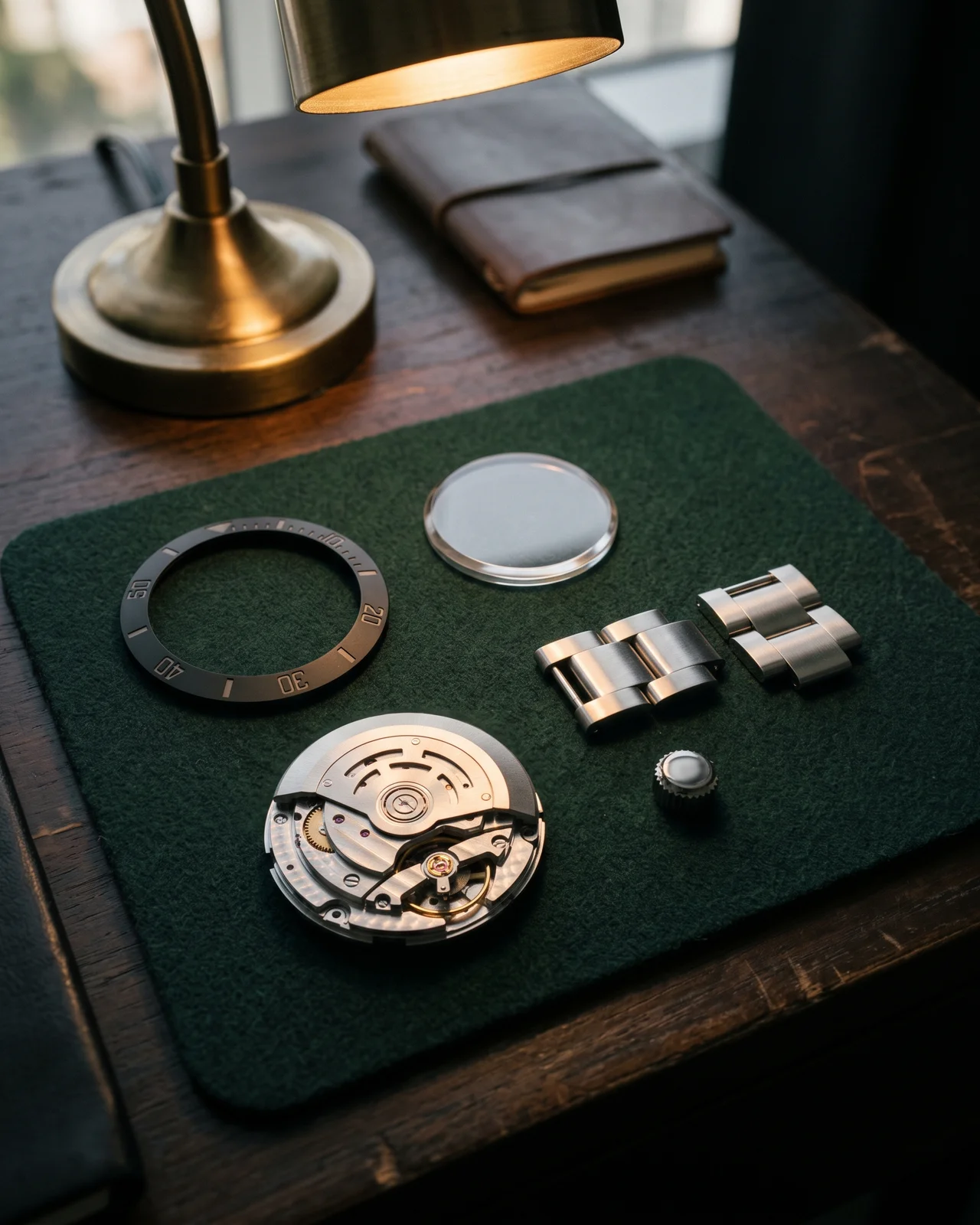
- Oystersteel. Rolex's name for the 904L stainless steel it uses across the range. Most other brands use 316L. Both are steel; 904L polishes brighter.
- Rolesor. Rolex's name for steel and gold on one watch: steel case, gold bezel, crown, and centre links. Two-tone, in plain words. Rolesium is steel with a platinum bezel, on the Yacht-Master.
- Everose. Rolex's own rose gold alloy. Sedna is Omega's. Both resist fading; older rose gold can drift toward yellow.
- Cerachrom. Rolex's ceramic bezel insert, on sport models since the 2000s. Does not fade; chips only under hard impact.
- Aluminium insert. The painted bezel insert on older Submariners and GMT-Masters. It fades, which collectors like, and gets replaced at service, which they do not.
- Ceratanium. IWC's ceramised titanium. Titanium itself is light, dull grey, and scratches easily: Tudor Pelagos, some Panerai and IWC.
- Sapphire crystal. The scratch-resistant glass on most modern watches. Chips rather than scratches.
- Hesalite. Acrylic crystal, on the Speedmaster Moonwatch and vintage Rolex. Scratches easily and polishes out; cracks rather than shatters.
- Precious metals. Yellow, white, and rose gold, and platinum, which carries the ice blue dial on Rolex. On a Day-Date the metal is the floor of the offer, not the offer.
- Lume. The luminous material on dial and hands: tritium up to the late 1990s, Luminova and Super-LumiNova after, Chromalight on modern Rolex. The type should match the watch's era.
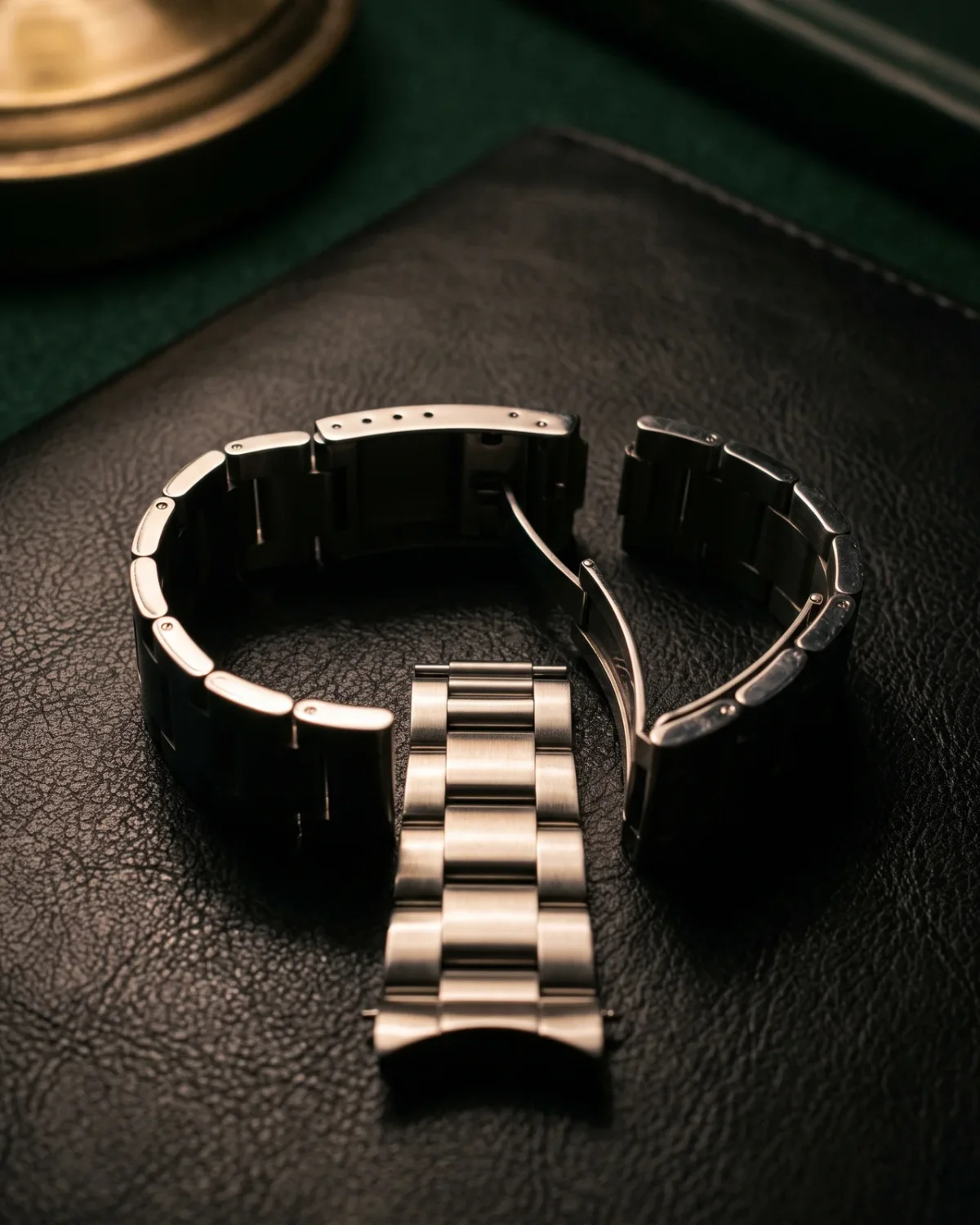
- Jubilee, Oyster, President. The three Rolex bracelets: five-link, three-link, and the semi-circular link reserved for the Day-Date and some gold Datejusts.
Condition and paperwork terms
The words in an offer that move the number most.
- Unpolished. The case has never had metal removed to hide wear; edges and bevels as they left the factory. Priced above polished examples of the same reference.
- Polished. Metal removed at least once, usually at service. Not a fault when disclosed. Priced below unpolished; over-polished further below.
- Honest wear. Scratches and small dings from use with the edges intact. Priced as wear, not as damage.
- Service parts. Dial, hands, bezel insert, crystal, or clasp replaced at service with current parts. The watch runs well and loses collector interest, most of all on vintage sport references.
- Service dial. A factory replacement dial fitted at a brand service. Correct for the watch, not original to it. A redial is a dial repainted outside the factory, and is priced as a replacement.
- Tropical, patina. A black dial aged evenly to brown, or lume and dial aged evenly. Collector traits when genuine. Spotting and moisture damage are not patina.
- Bracelet stretch. Hollow links worn where the pins sit, so the bracelet sags. Common on older Jubilee and President bracelets; priced as a bracelet that needs work.
- End links and clasp code. The pieces joining bracelet to case, and the stamped code inside a Rolex clasp. Both date the bracelet, not the watch, and should match it.
- Aftermarket. Any part not made by the brand: a bezel, a dial, a strap, stones set later. Priced as a modification; stones set later cost the most. Factory set is the opposite.
- Warranty card. The modern record of first sale: serial, reference, dealer, date. The single most useful document.
- Punched papers. The older paper certificate, punched or stamped with the serial by the dealer. The same job as the card. Patek Philippe calls its paper the Certificate of Origin.
- Extract from the Archives. A document from the brand's own records confirming a watch's reference, movement and case numbers, and sale date. Patek Philippe issues them; Audemars Piguet and Omega have too. Rolex does not.
- Service record. A receipt or brand service card listing what was done and replaced. Turns unknown history into known history.
Deeper: the condition guide, the box and papers guide, and the polishing guide.
Two crystals
Sapphire against hesalite.
The one materials choice a buyer still makes, on the Speedmaster Moonwatch, and the one a seller cannot reverse on a vintage Rolex.
| Criteria | Sapphire | Hesalite (acrylic) |
|---|---|---|
| Scratches | Very hard to scratch | Scratches easily; light marks polish out |
| Impact | Can chip or crack at the edge | Cracks rather than shatters; cheaper to replace |
| Where it belongs | Nearly every modern watch, including modern Rolex | The Moonwatch, vintage Rolex, vintage Omega |
| On an offer | Expected on a modern reference; a chip is a repair | Expected where original; a sapphire fitted to an acrylic-era Rolex is priced as a modification |
| When it wins | A daily wearer you will not baby | Originality on a vintage piece, or the Moonwatch as issued |
On the Moonwatch, Omega offers both, and neither is wrong. On a vintage Rolex, the original crystal type is the right one.
Questions, answered
The terms people ask about most
What does full set mean?
The watch with its box, warranty card or punched papers, booklets, hang tags, and every spare link. The card or papers prove the watch; the rest completes it. A full set earns more.
What does unpolished mean, and why does it matter?
The case has never had metal removed to hide wear, so the lug bevels and edges are as they left the factory. Unpolished examples trade above polished ones of the same reference, because a polish cannot be undone.
What are service parts?
A dial, hands, bezel insert, crystal, or clasp replaced at service with current factory parts. The watch runs well and collectors pay less, because the original parts are what they collect.
What is the difference between a chronometer and a chronograph?
A chronometer is a movement that passed an accuracy test, COSC or the brand's own. A chronograph is a stopwatch function with pushers. A Daytona is both; a Datejust is a chronometer and not a chronograph.
The ones that move the number
Six terms that change an offer.
Unpolished
Edges as they left the factory. The premium condition on any reference, and most of the value on a vintage sport watch.
View →Full set
Card, box, booklets, tags, links. The card proves; the rest completes. Earns more, especially on a watch that sold above retail.
View →Service parts
Replaced dial, hands, insert, or crystal. Reliability up, collector interest down. Disclose them.
View →Reference
The model code, and the first filter on which comparables an offer is built from.
View →Serial
Unique to the watch. Dates an older Rolex and says which parts belong on it.
View →Aftermarket
Any part the brand did not make. Priced as a modification, and stones set later cost the most.
View →Why the words matter
What knowing the terms gives you.
The same language as the offer
An offer here says unpolished, service insert, full set, and shows the reasoning. Knowing the words means you can check it.
A warning in a listing
Mint and all original with no photos of the lugs, or chronometer used to mean chronograph, tells you how much the seller knows.
Unworn is not new
Unworn is pre-owned with stickers. The warranty runs from the card date, not from the day you buy it.
Every watch sold, authenticated in person
Whatever the listing says, each watch sold here is inspected in person before it ships and guaranteed genuine.
Know the words?
Describe the watch in them, and send the photos.
Reference, condition in these terms, what came with it, and photos in window light. I reply personally within 1 business day with an offer and the reasoning.