
About · The authentication standard
What authenticated means when I say it.
Every watch I buy and every watch I sell goes through the same inspection, by me, in person, in the same order. This page states that standard: what I check, what fails a watch, what only lowers the number, and what happens on a fail. It is for the remote buyer, the seller with no papers, and anyone who has been burned before.
- Case, bracelet, dial, crown, movement, serials, history: in that order, every time
- Replacement parts sold as original fail. Service parts, disclosed, only lower the offer.
- Nothing is authenticated from email photos alone
- Every watch I sell is guaranteed genuine and as described, or it comes back at full price
Who this page is for
Three people who need the standard before they trust the number.
The remote buyer, who will wire money for a watch seen only in my photos and on a call. The seller whose watch came without papers and who wants to know whether that is a problem or just a line in the arithmetic. And the person who bought a watch somewhere else, found out later what it really was, and is not going to let that happen twice.
The fake-spotting guide on this site is written for your own eyes: what to look for on a listing before you meet a seller. This page is different. It is the commitment behind the word authenticated on every watch page and every offer: the inspection I do, in order, and the consequences of what I find.
It is also a plain list of what I will not do, because a standard that can be skipped for a client in a hurry is not a standard.
The inspection order
Six passes, outside in, every watch.
The order matters. The outside tells me what to expect inside; the serial tells me whether the outside left the factory with this watch.
01
Case and lugs
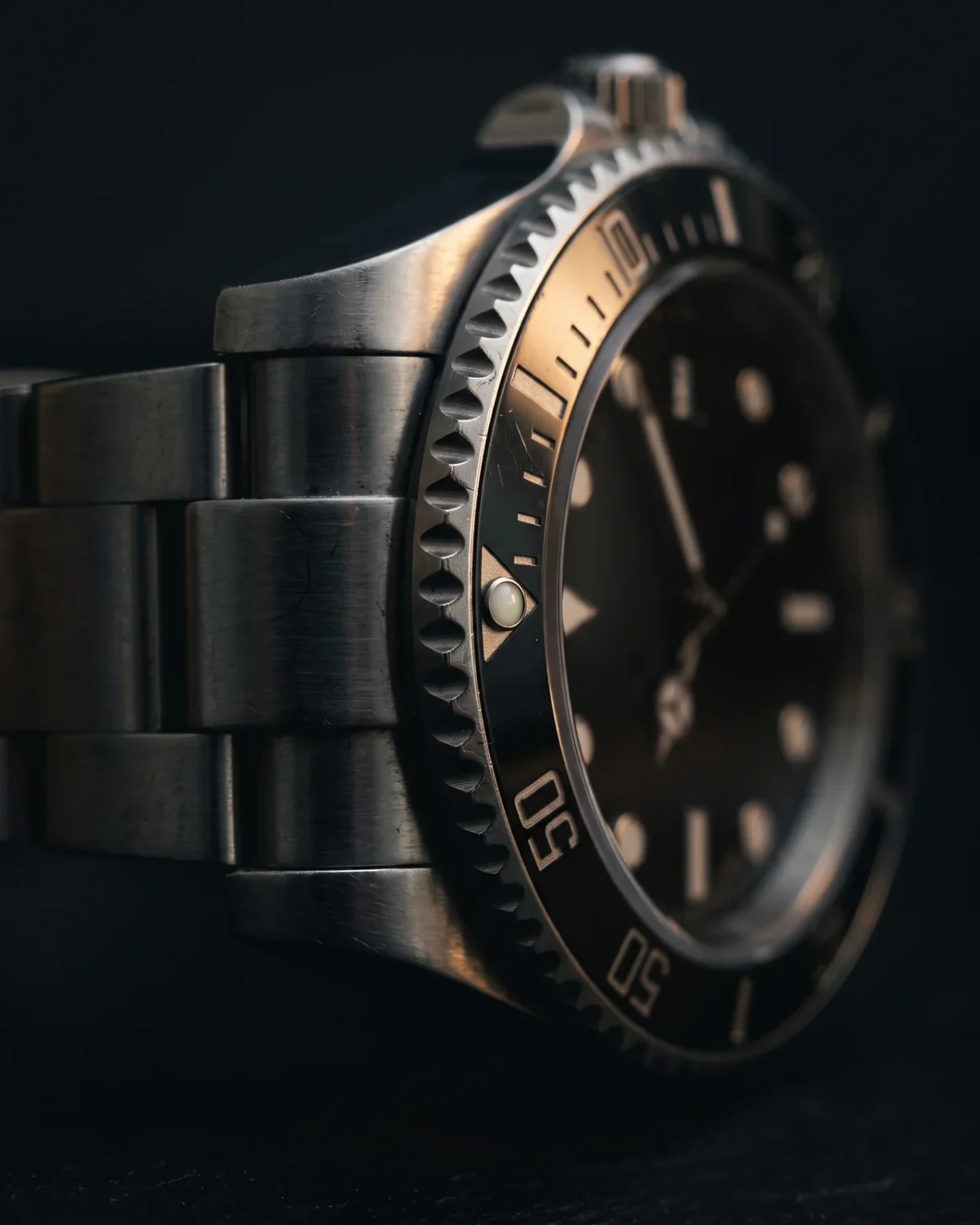
Case shape, lug thickness, bevels, and brushing against what that reference should show. Over-polishing, replaced case parts, and a case that does not belong to the serial show up here first.
02
Bracelet and clasp
Clasp code and end links against the age of the watch, stretch between links, replaced or aftermarket parts. A correct bracelet on the wrong watch is one of the commonest substitutions.
03
Dial and hands under magnification
Printing sharpness, luminous material matched between dial and hands, ageing that agrees across both, redial traces, replaced hands. Most of what fails a watch is found here.
04
Crown, tube, case back, and movement
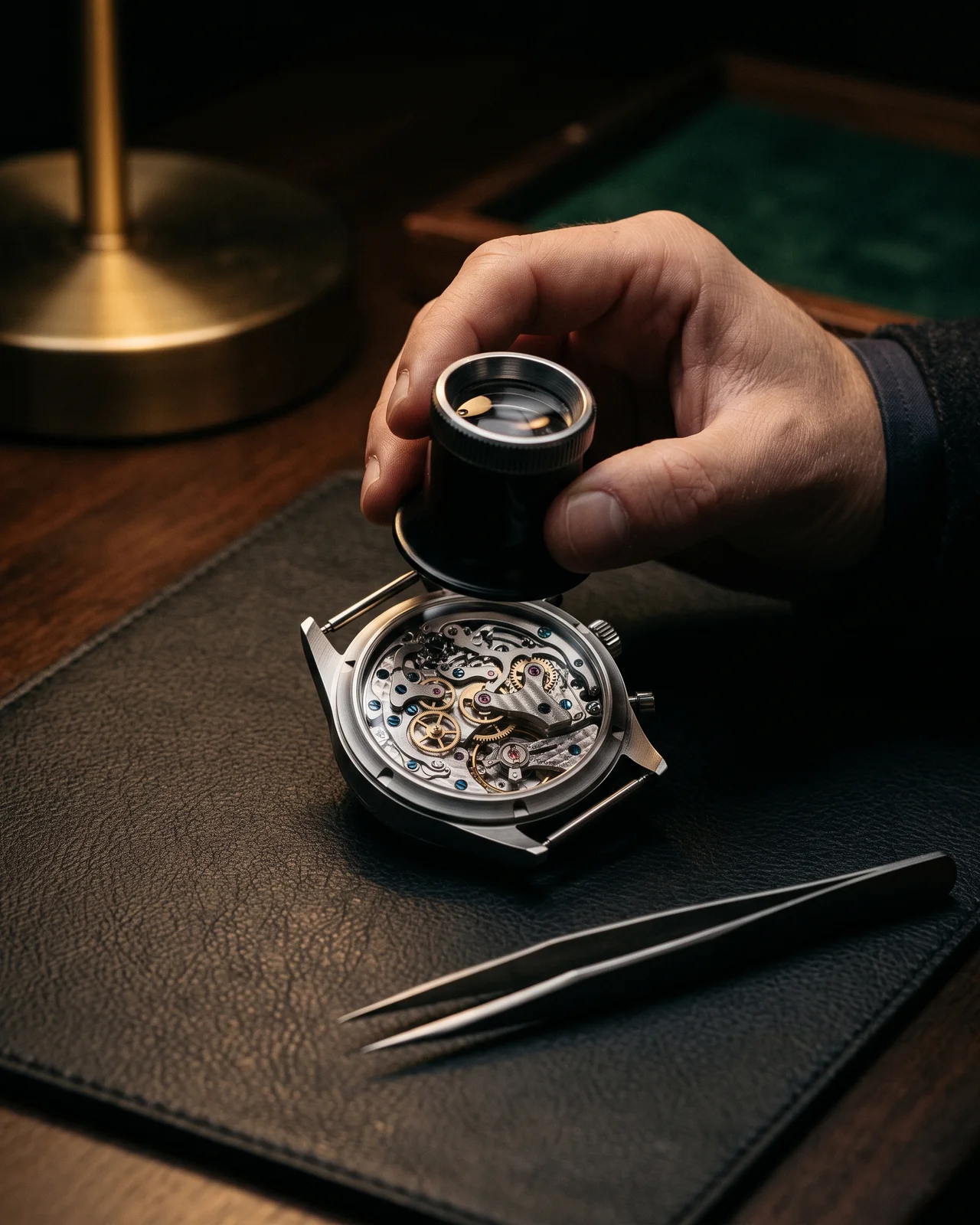
Crown signature and tube fit, then the case back comes off. The calibre, finishing, and parts are checked against what that reference carries. A clone movement or a franken assembly ends the inspection.
05
Serial and reference against the papers
The case serial and reference against the warranty card or punched papers, and against the known production ranges for that reference. A mismatch is a fail, not a discount.
06
Service history
Service cards, receipts, and the parts that were replaced. Service parts are not a fail, but they are disclosed and they move the number.
The standard
What fails, what lowers, and what I guarantee.
What fails a watch
A fail means I will not buy the watch and will not sell it, at any number. These are the reasons. They are not negotiable, because the next owner would rely on my word.
- A replacement dial or replacement hands presented as original.
- A redial: an original dial refinished and passed off as untouched.
- A franken piece: a genuine case with another watch's movement, dial, or bracelet, assembled to look like one reference.
- A serial that does not match the papers, or a serial and reference pairing that never left the factory together.
- Aftermarket parts that were not disclosed: bezels, inserts, crystals, crowns, or bracelet parts the seller did not mention.
- A movement that is not the calibre the reference carries.
What lowers an offer without failing it
Honest wear and honest service are not fakes. A service dial or service hands fitted by the brand and disclosed, a polished case, a replaced crystal or bezel insert, an aftermarket strap on an otherwise correct watch: each is noted, photographed, and priced. The direction is down, because collectors pay for original parts and unpolished metal, but the watch stays in the deal. The difference between this list and the one above is disclosure. The same service dial that lowers the number when you tell me about it fails the watch when you do not.
Why a full set helps, and why it proves nothing
Box and papers raise the offer because the next buyer wants them, and because a card that matches the case serial lets the watch be traced to its first sale. They are not proof. Boxes and cards are faked, and a convincing card next to a bad watch means nothing. A real watch can also arrive in a fake box. So the card is checked against the watch, never the other way round, and a watch with no papers is bought on the strength of the six passes. The box and papers guide covers what each document is worth.
What happens when a watch fails
It goes back to you on the same insured service it arrived on, at no charge, and I tell you exactly why: which part, what I saw, and what would change the answer if anything would. I do not sell a written report on it, I do not keep a list of sellers who sent me one, and I do not discuss it with anyone. Most people who send a fail did not know; they bought in good faith from a listing that looked fine. The fake-spotting guide exists for them, and it is better read before the next purchase than after.
The guarantee on what I sell
Every watch I sell is guaranteed genuine, as described, with any service history and provenance I hold disclosed in full. If a piece is ever proven otherwise, it comes back at full price, with no time limit. Remote buyers get detailed photos, video, and a call walking through the piece before anything ships, and an inspection window on arrival, stated in the terms. In South Florida you can see the watch across the table, by appointment.
What I will not do
- Authenticate a watch from email photos alone. Photos start the conversation; the inspection is in person.
- Quote a price by email without photos, or on a 5711 at all. Call me.
- Sell a watch with hairlines I have not photographed.
- Skip a pass because the papers look right, the seller is a friend, or the buyer is in a hurry.
When this standard is not what you need
This is a purchase and sale inspection. If you want a document certifying a watch you intend to keep, that is a watchmaker or the brand's own service centre, not a dealer. If you want a written valuation for insurance or an estate, that is an independent appraisal, which an offer is not. And if you are buying from a stranger on a marketplace, none of this reaches you; run the fake-spotting guide yourself.
Dealer or marketplace
An inspected watch against a listed one.
A marketplace listing can be honest. The difference is who checked, and who answers if it was not.
| Criteria | Bought from me | Bought from a marketplace listing |
|---|---|---|
| Who inspected it | I did, in person, in the six passes above | Usually the seller; sometimes a platform photo review |
| Movement checked | Case back off, calibre and parts verified | Rarely; most listings show the dial and the box |
| Serial and papers | Matched to the watch and to the production ranges | Papers shown, seldom matched to the case |
| Service parts | Disclosed in the listing and priced into it | Disclosed if the seller knows, or chooses to |
| Before money moves | Photos, video, and a call for remote buyers; across the table in South Florida | Listing photos and messages |
| If it is not as described | Back at full price, with no time limit | Platform dispute rules, deadlines, and the seller's goodwill |
| Where the marketplace wins | A narrower stock: I have what I have | Breadth and the chance of a bargain, checking left to you |
The dealer-versus-marketplace comparison weighs the whole purchase, not just authenticity.
Questions, answered
Authentication, in short
Do you buy watches without box and papers?
Yes. A full set earns more, but a correct, honest watch stands on its own after the six-pass inspection. Every piece is authenticated in hand, whatever paperwork comes with it.
Is every watch you sell guaranteed genuine?
Yes. Genuine, as described, with any service history and provenance I hold disclosed in full. If a piece is ever proven otherwise, it comes back at full price, with no time limit.
Can I see a watch before buying?
In South Florida, yes, by appointment. Remote buyers get detailed photos, video, and a call walking through the piece before anything ships, plus an inspection window on arrival stated in the terms.
Can you authenticate my watch from photos?
No. Photos are enough to start an appraisal and to spot an obvious problem, but authentication happens in person, with the case back off. Nothing is called genuine from an email.
Brand by brand
What the same standard looks like on each brand.
The six passes do not change. What I expect to find in each one does. The sell pages go deeper per brand.
Rolex
The serial engraving should sparkle under raking light, not sit flat and grey. The rehaut lettering aligns to the minute track. Inside, the Parachrom hairspring is the hardest part to fake.
View →Patek Philippe
The certificate of origin and, on older pieces, an extract from the archives are matched to the case and movement numbers. Sealed sets stay sealed until the inspection.
View →Audemars Piguet
Royal Oak bracelet facets and the case bevels show polishing before anything else does. Cards and the generation of the reference are checked against the case.
View →Omega
Speedmaster variants are checked by calibre, dial, and case back. Master Chronometer cards and archive extracts confirm the pairing.
View →Vacheron Constantin
Archive extracts and the Hallmark of Geneva on the movement, where the reference carries it, are confirmed with the case back off.
View →Breitling
In-house or supplied calibre against the reference and generation, and the chronometer papers against the serial.
View →What the standard gives you
The same inspection, on both sides of every deal.
Inspected by the person who pays you
I do the six passes myself. Nothing goes to a grading team you never speak to; the person who found the service dial explains the number.
No papers is a line item, not a wall
A watch without its card is bought on the strength of the inspection. The offer shows what the missing card cost, for that reference.
Remote buyers see it first
Photos, video, and a call before anything ships, and an inspection window on arrival stated in the terms. The watch you receive is the one you were shown.
Trades are checked the same way
The watch you trade in gets the six passes. The watch you trade toward already had them. Neither side relies on a listing.
A fail stays between us
If your watch does not pass, it goes home insured at no charge, you are told why, and nobody else hears.
Put it to the test
Send the watch you are not sure about.
Photos and a few details start the appraisal. The inspection on this page happens next, in person, and you hear exactly what it found. Or browse the case, where every piece has been through it.