
Sell your Constellation · South Florida · by appointment
Sell your Constellation to a dealer who knows which Constellation it is.
A two-tone quartz Manhattan, a Globemaster, and a 1960s pie-pan in gold are three different sales. Send photos of the dial, the case back, and any cards. I reply within 1 business day with a number and the path it took.
- Manhattan, Globemaster, and the current Master Chronometer references
- Vintage pie-pan and C-shape references quoted in person
- Estate pieces welcome, with or without papers, in your county
Who this page is for
Most Constellations I see were someone else's first.
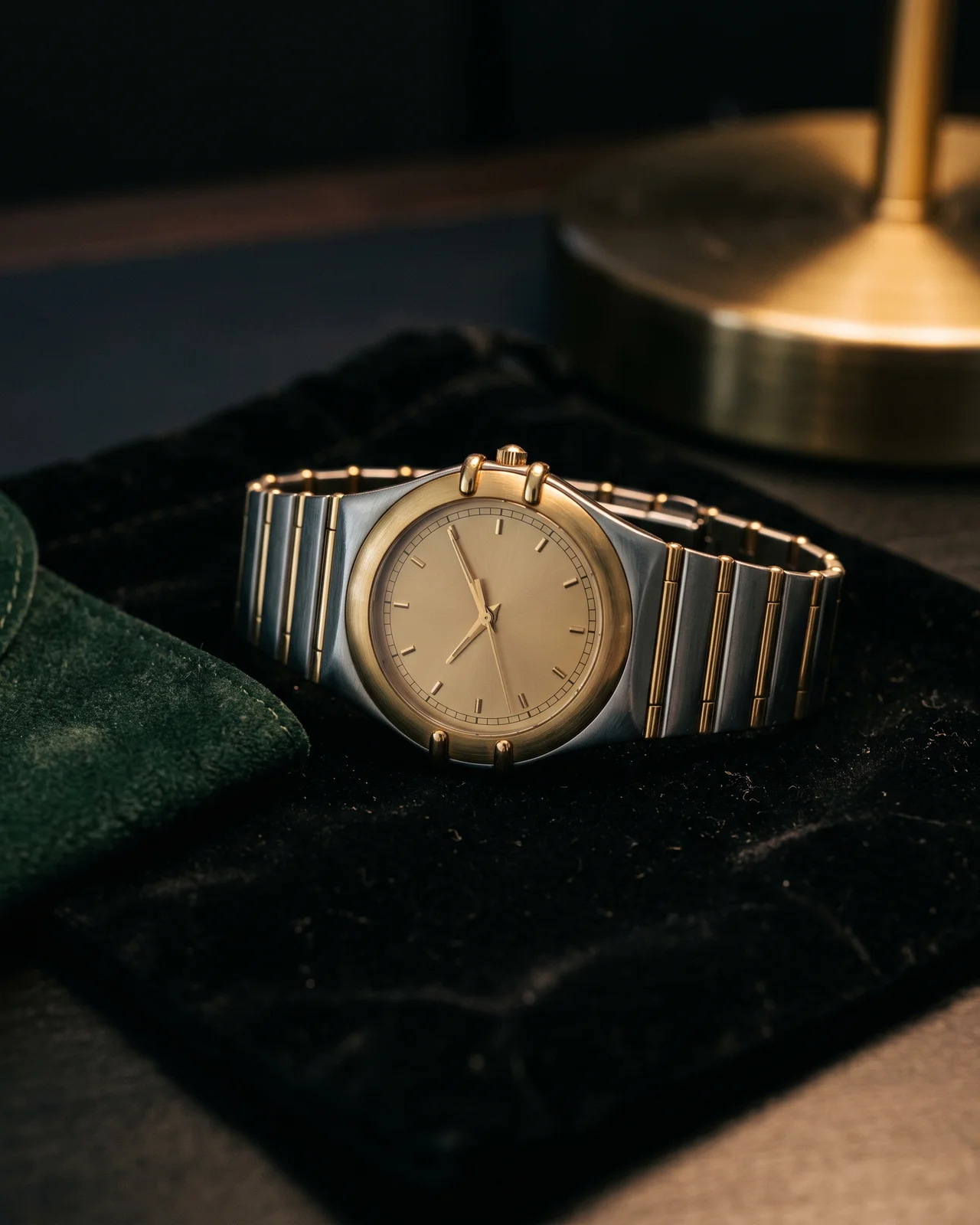
This page is for the person holding a Constellation and asking whether it is worth selling. Often it came from a parent. Often it is two-tone, runs on a battery, and has four claws at the sides of the crystal. Sometimes it is older and gold, with a dial that slopes at the edge like an upturned pie pan.
The name has covered a chronometer line since the early 1950s, a quartz design icon from 1982, and a Master Chronometer line today. The offer swings between those paths. A 1990s quartz two-tone is often priced close to its gold. A Globemaster trades on its set. A vintage pie-pan in solid gold is quoted in person, because the dial decides it.
Below I separate those paths. The Master Chronometer card, the Extract of the Archives, and service parts in general stay on the Omega page.

Selling a Constellation to me
What changes when the dealer sorts the paths before the price.
Metal floor first, then the watch
On a gold or two-tone Constellation I work out what the metal is worth and what the watch is worth, and show you both. The higher number is the offer.
Vintage read from the dial, not the name
A 1950s or 1960s Constellation lives or dies on an original dial. I check the pie-pan edge, the star, and the lume before I quote it, usually in person.
Globemaster and Master Chronometer sets
The current references come with the warranty card and the Master Chronometer card. I check both against the case back and price the complete set as one.
Paid within 24 hours of inspection
Wire or check, your choice, once the watch has been inspected in person and matches the photos.
What I check on a Constellation
Five things that decide the offer on this model.
Each one moves the number. I explain which way in the reply.
Generation
The 1982 Manhattan, the 1990s quartz and diamond versions, the 2009 refresh, the Master Chronometer line, and the Globemaster. Each has its own buyers.
Quartz or co-axial
Most Manhattans from the 1980s and 1990s are quartz. The current line runs Co-Axial Master Chronometer calibres. The movement sets the market before anything else.
Gold-capped, two-tone, or solid gold
Solid gold carries hallmarks and sets a metal floor. Gold-capped is a layer of gold over steel. Two-tone sits between. I check the back and the links, not the colour.
Diamond bezels and dials
Omega set diamonds on many Constellation bezels and dials, mostly in the ladies' sizes. Factory stones are priced with the watch. Aftermarket stones are not.
The pie-pan dial
On vintage references the stepped dial, the applied star, and original lume carry the value. A refinished dial runs fine and sells far lower.
How it works
Four steps. Real numbers.
01
Get an offer
Send the appraisal form with the dial straight on in daylight, the case back, both sides of the case, the bracelet laid flat with the clasp open, and any cards. On a vintage piece add a close shot of the dial edge and the star. I reply within 1 business day.
02
Ship or meet
Use the prepaid, fully insured FedEx label, or book an appointment in Miami-Dade, Broward, or Palm Beach. For a vintage pie-pan or a solid gold piece I prefer to meet.
03
Inspect and confirm
I open the box on camera and check the movement, the metal, the dial, the bracelet, and the cards against the photos. If it matches, the offer stands.
04
Get paid
Wire or check within 24 hours of inspection. If we do not agree, the watch comes back to you, insured, at my cost.
Constellation or Globemaster
The two paths a modern Constellation can take.
Same family, very different watches to the buyers I sell to.
| Criteria | Constellation Manhattan line | Globemaster |
|---|---|---|
| Era | 1982 to today, through the quartz years, the 2009 refresh, and the Master Chronometer references | 2015 onward, built on the pie-pan look of the 1950s and 1960s |
| Movement | Quartz on most 1980s and 1990s pieces; Co-Axial from 2009; Master Chronometer since | Master Chronometer from the first reference; an annual calendar version followed |
| Dial and bezel | Flat dial, claws at three and nine, Roman numerals on the bezel of many references | Twelve-sided pie-pan dial under a fluted bezel |
| What moves the offer most | Metal, movement type, and bracelet condition | Full set with both cards, and case condition |
Directions, not figures. I show the arithmetic in the reply.
The detail
What moves a Constellation offer, and why.
The Manhattan, the claws, and the quartz years
Omega launched the Manhattan in 1982. Its four claws pressed the sapphire crystal onto its gasket, and the bracelet ran into the case without lugs. Most were quartz, and two-tone was the popular finish. By the 1990s the line ran to ladies' sizes, diamond bezels, and a mix of quartz and automatic references. Every later generation kept the claws.
What a 1990s two-tone quartz Constellation is really worth
It is a good watch and a common one, and the market for it is steady but not deep. The offer on a two-tone example often sits close to the value of the gold in it, plus something for a working, complete watch. A fresh battery, the full bracelet, and the box and papers move it up. A dead movement, a stretched bracelet, and plating worn through move it down. Many sellers arrive with a figure from a listing for a new piece. The name is the same, the watch is not, and the reply explains the gap.
The 2009 refresh and the Master Chronometer line
Omega reworked the Manhattan around 2009. The claws stayed but no longer held the crystal, and the larger sizes carried Co-Axial automatics. From around 2018 the line moved to Master Chronometer calibres tested by METAS, with 39 mm and 41 mm men's references following. These trade on a full set: both cards and the box, with numbers that match the case back. Without the cards the watch is still bought, and the offer is lower by an amount I name.
The Globemaster: a Constellation by family, not by name
The Globemaster arrived in 2015 at 39 mm. It takes the pie-pan dial and fluted bezel from the 1950s and 1960s Constellations and puts a Master Chronometer calibre behind them. It was the first watch to carry that certification, and the case back shows the observatory medallion with its eight stars. An annual calendar version at 41 mm followed, in steel, Sedna gold, and two-tone. Collectors treat it as its own line, so I price it on Globemaster sales. The fluted bezel shows wear at the ridges first.
Vintage pie-pan and C-shape references
The Constellation began in the early 1950s as Omega's chronometer line. The 1950s and 1960s references carry the 500-series automatic calibres, such as the 551 and 564, a stepped dial collectors call the pie-pan, an applied star above six o'clock, and the observatory medallion on the case back. In the later 1960s the case changed to the rounded C-shape with a flatter dial. On these watches the original dial is nearly everything. Refinished dials are common and often look better in a photo than originals. I quote vintage Constellations in person, because the dial print, the lume, and the case edges cannot be judged from a phone. The Omega page explains when an Extract of the Archives pays.
Gold-capped, plated, and solid gold
Vintage Constellations came in steel, in solid gold, and in gold-capped cases: a thick layer of gold bonded over a steel body, often with a steel case back. Solid gold carries hallmarks and sets a floor under the offer. Capped is not plated, and it wears far better, but it sets no floor. On a two-tone Manhattan the gold is trim, and on some references part of it is plated. I check the hallmarks and the links, not the colour in the photo.
Diamond bezels, ladies' sizes, and aftermarket stones
Omega set diamonds on Constellation bezels and dials at the factory, mostly in the smaller sizes, and factory stones are priced with the watch. Stones added later by a jeweller do not add to the offer, and I price the reference underneath them. Do not have them removed. The small ladies' quartz pieces have a thinner market than the men's sizes, and I say so in the reply.
When selling to me is not the right call
If a two-tone quartz piece is worth only its gold, a refiner may pay about the same, and I will tell you. If it was a parent's watch and you are not sure, keep it. If you hold a rare vintage dial and have months to find the right collector, a dealer offer sits under that ceiling. If the plating is worn through and the movement is dead, it may not be worth shipping. If you want an insured sale with the money within a day of inspection, send it in.
How to prepare your submission
- Dial straight on in daylight, flash off. On a vintage piece, a second photo at a low angle so the stepped edge and the star show.
- The case back with the medallion or reference legible, and the inside of the clasp for hallmarks.
- Both sides of the case, and the bracelet laid flat with the clasp open.
- Any cards or old papers beside the watch. If there are none, say so.
- Whether it is running, and which county you are in.
Questions, answered
Before you send a Constellation
Is my two-tone quartz Constellation worth much?
It is worth something, and often not much more than its gold. A working movement, the full bracelet, and the box and papers raise it. I show you the metal number and the watch number side by side.
Do you buy old pie-pan Constellations?
Yes, and I prefer to see them in person. The original dial, the lume, and the case edges decide the value, and none of that reads well from a phone photo.
Is the Globemaster a Constellation?
By family, yes. It carries the Constellation pie-pan dial and medallion. Collectors treat it as its own line, so I price it against Globemaster sales, not Manhattan sales.
Is gold-capped the same as gold?
No. Gold-capped is a thick layer of gold over steel, usually with a steel case back. It wears well but sets no metal floor. Solid gold carries hallmarks and does.
What if I have no papers?
I still appraise it. Papers are rare on a vintage or 1990s piece anyway. On a recent reference or a Globemaster the cards matter more, and I show you by how much.
Sell your Constellation
A real number on your Constellation, in 1 business day.
Send photos and whatever papers you have. I reply personally with the metal floor, the watch value, and which path it took. Insured shipping is on me. Payout within 24 hours of inspection.